
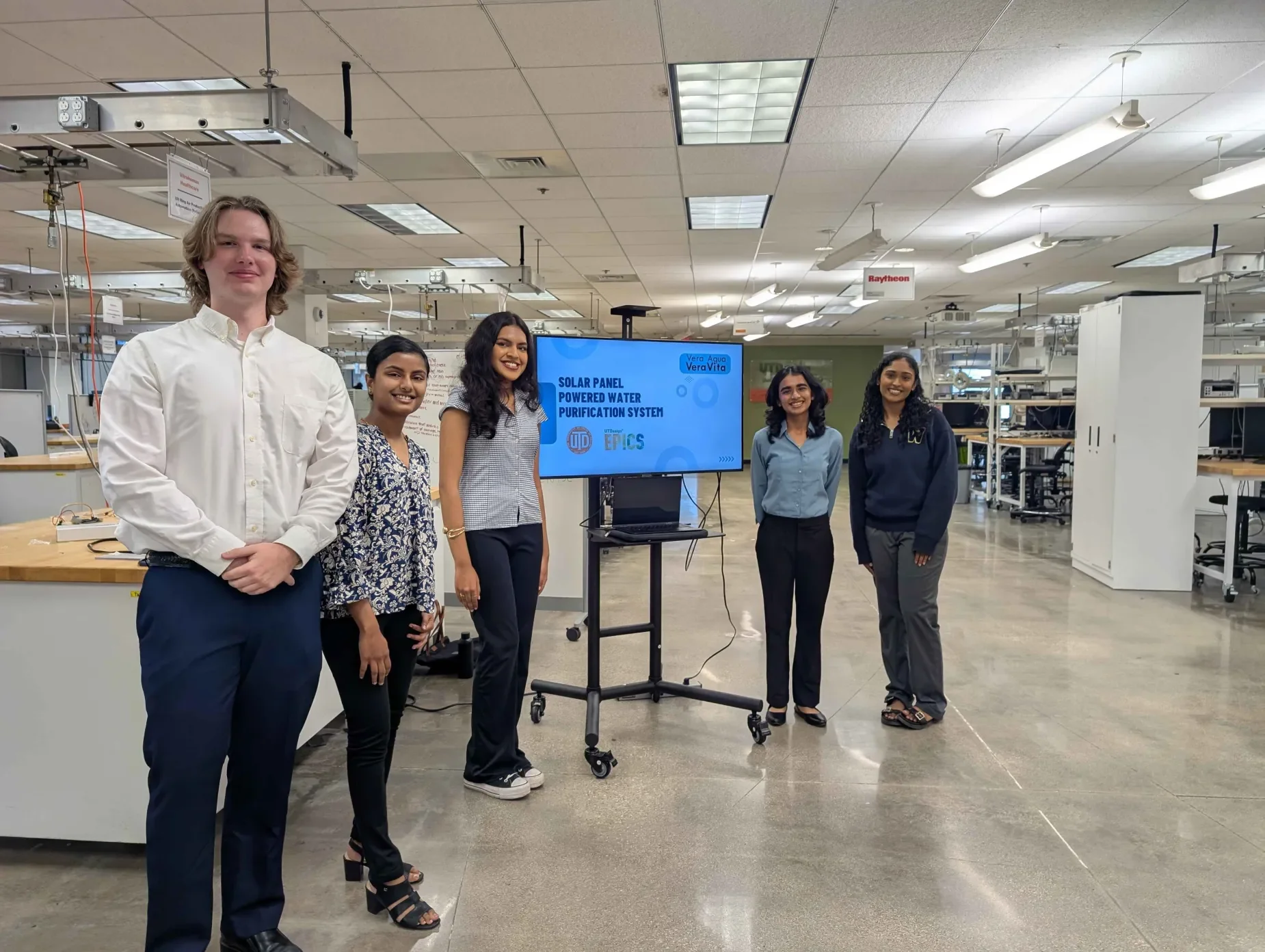
Students at the University of Texas at Dallas are transforming how the world approaches clean water access. This semester, VAVV was selected as a project partner for UTD’s EPICS (Engineering Projects in Community Service) program, a competitive, project-based initiative where student teams are chosen to tackle real-world challenges. Through this partnership, a multidisciplinary EPICS team worked with VAVV to create a build-ready, solar-powered system designed to support a water generator in Piura, Peru. The VAVV EPICS team included Varsha Shashishekar (Electrical Engineering, Project Partner Liaison), Aidan Loran (Computer Science, Mentor Communication Lead), Josphin Kallery (Electrical Engineering Project Lead), Jerusha Pandi (Computer Science, Document Manager), and Kasish Jain (Computer Engineering), each contributing their talents and expertise across multiple semesters to bring the project to completion.
At its core, the project centers on a simple yet impactful idea: using solar energy to power an atmospheric water generator, a device that pulls moisture from the air and condenses it into clean drinking water, like condensation forming on the outside of a cold glass. It can produce up to 120 gallons of clean water per day—even in places without existing water or electrical infrastructure.
“We designed a container and solar panel system that allows the Genesis Water Cube to sustainably create water for a community in Piura,” said Varsha Shashishekar, an Electrical Engineering student and Project Partner Liaison on the project.
The system includes solar panels, battery backup, and safety features designed with long-term community use in mind. Since the Water Cube pulls moisture directly from the air, it can work without rivers, wells, or infrastructure, making it the ideal solution for rural or underserved communities.
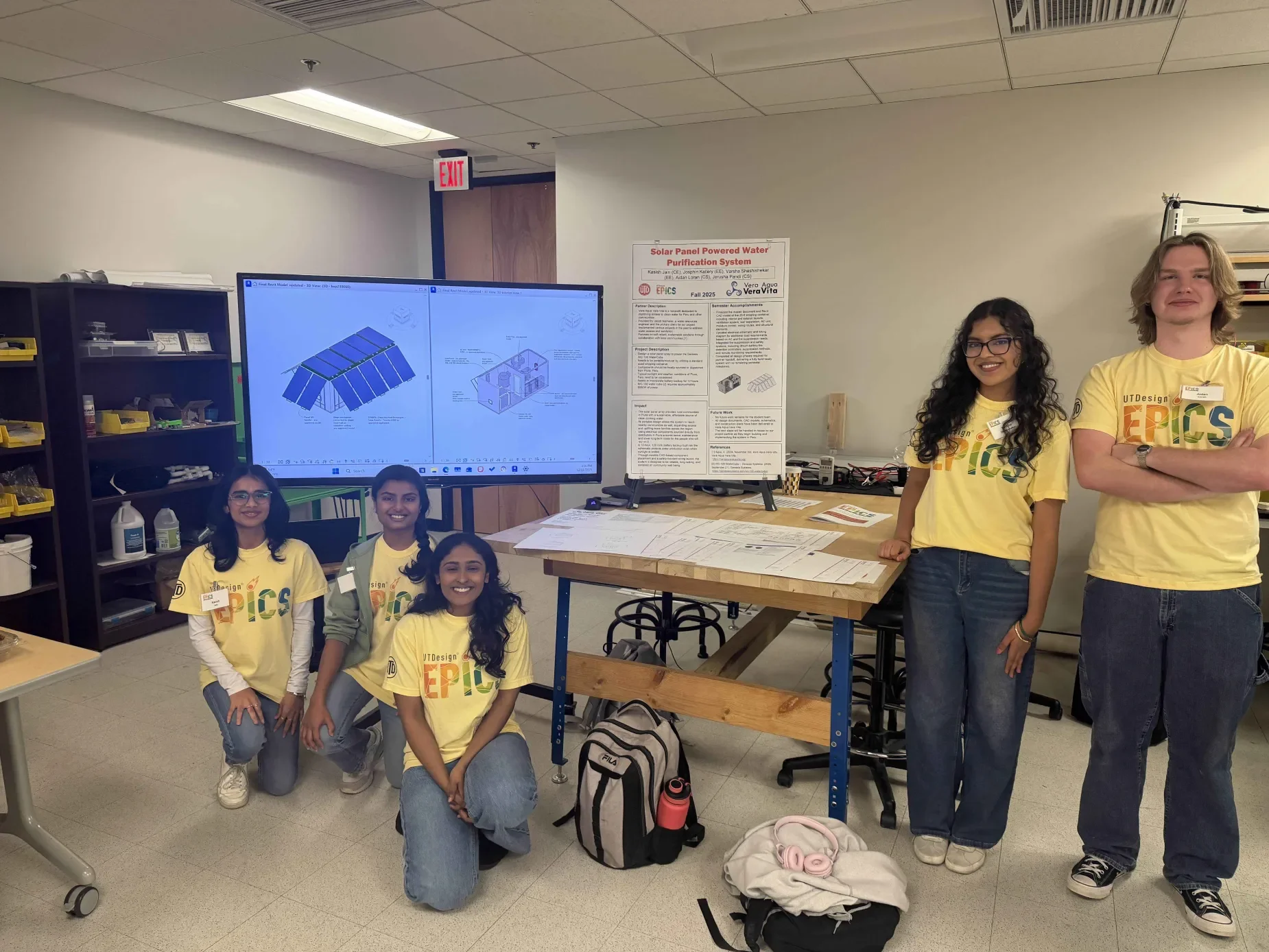
By the end of 2025, the EPICS team delivered a completed set of blueprints, diagrams, and cost estimates to VAVV which were approved as “build-ready.”
“‘Build-ready’ means construction could start today,” said Aidan Loran, a Computer Science major and Mentor Communication Lead. “VAVV can now begin planning labor, sourcing materials, and preparing for deployment.”
Reliable electricity is not a given in many rural communities, which made solar power and backup energy essential elements to the final project. The system is fully off-grid, with solar panels mounted on the container roof and batteries capable of providing up to 12 hours of backup power.
“Solar paired with battery backup gives communities stability,” said Josphin Kallery, an electrical engineering project lead. “Even when sunlight isn’t available, the system can continue producing water.”
Piura’s ample sunlight makes solar power a perfect source; clean, renewable, and abundant.
One of the most powerful aspects of this project isn’t just the technology—it’s the team behind it. Students from electrical engineering and computer science brought diverse strengths, ideas, and insights to the table.
“We all came from different majors, so we had to learn how to explain concepts clearly and pick up new skills together,” said Josphin. “None of us had a mechanical or civil background, but by working together, we were able to overcome obstacles “
Across every interview, one theme stood out: this system was built to last. The team intentionally prioritized local sourcing, clear documentation, and ease of maintenance so communities can take ownership of the system long after installation.
“We documented everything so local workers can participate in maintenance and operation,” Josphin said. From sourcing materials available in Peru to designing solar panels that can be installed by one person, the system was thoughtfully designed with longevity and resilience at the forefront.
“This represents the work of many students across many semesters,” said Jerusha Pandi, Computer Science Major and Document Manager. “I feel incredibly blessed to see all that effort come together to help those who need it.”
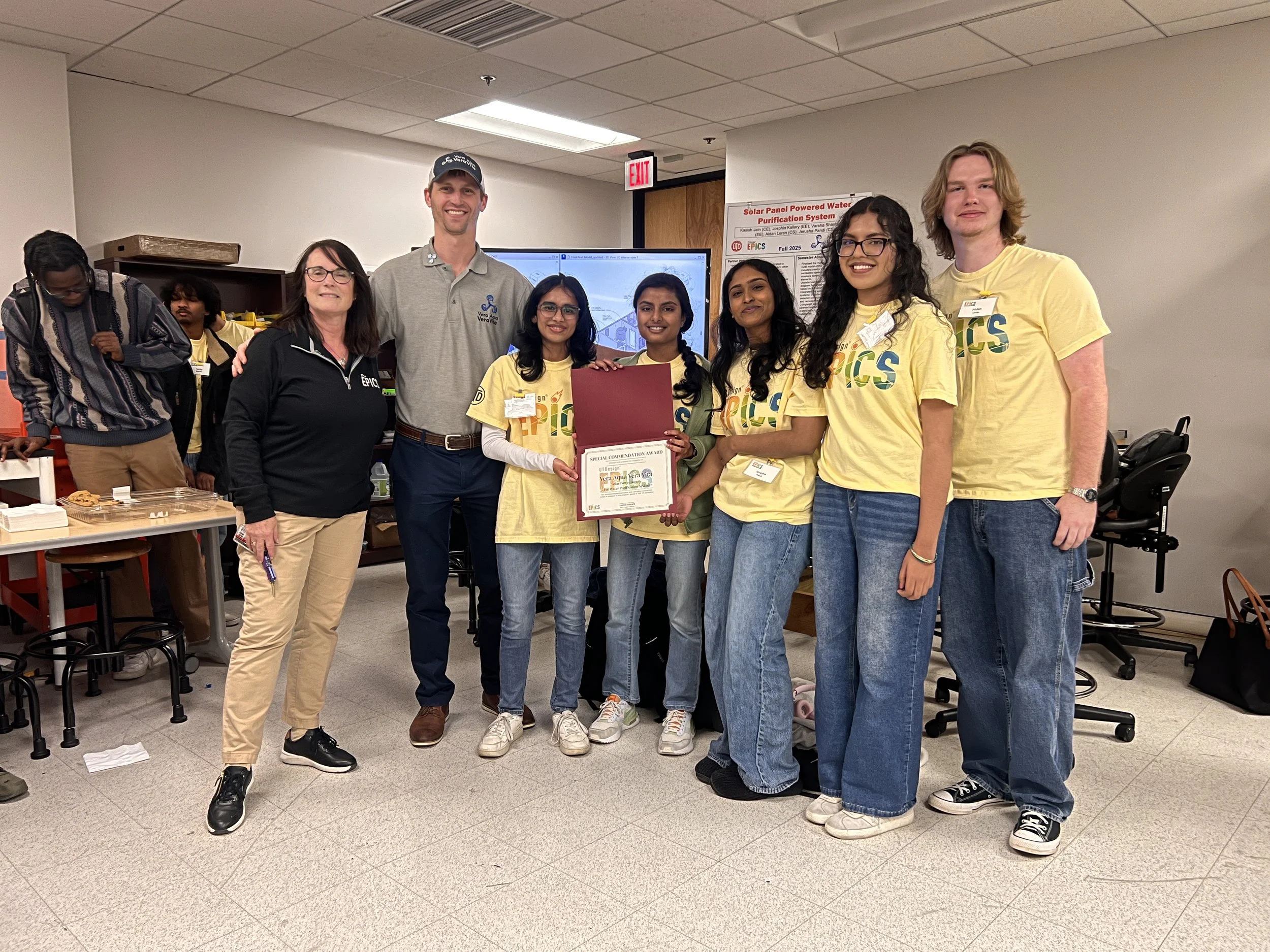
The team’s dedication was ultimately recognized with a Special Commendation Award from UTDesign EPICS; a moment of validation for countless hours of collaboration, perseverance, and care.
“Being part of this project was an incredible opportunity to contribute to a community-centered solution. I’m proud of how our team worked across disciplines to make the system practical, build-ready, and sustainable for Piura,” said Kasish Jain, a Computer Engineering student who contributed to the EPICS/VAVV team during the project’s final two semesters. Her reflection highlights the sustained and dynamic collaboration across multiple cohorts of interdisciplinary student groups, whose combined efforts carried the project through its final phase and toward implementation.
With a build-ready design in hand, the Genesis Water Cube project is now set to come to fruition. More importantly, it stands as an example of what’s possible when diverse areas of study come together around a shared purpose.
“I truly believe that the motivation behind the project - the purpose of serving the community - helped us overall despite our different skill sets,” said Josphin.
For VAVV, that motivation has never been stronger. This milestone brings us one step closer to realizing a community-centered clean water solution for Piura and communities beyond.